From building sciences, a solution has been proposed that allows improving the comfort and habitability of public schools.
By: Iván Tobar Bocaz, Journalist – Vice-Rectorate for Research and Development ivtobar@udec.cl
Images: UdeC Faculty of Architecture, Urbanism, and Geography
The project, led by Dr. Andrea Martínez Arias from the Faculty of Architecture, Urbanism, and Geography (FAUG) at the University of Concepción, aims to improve the environmental quality of the country’s public schools.
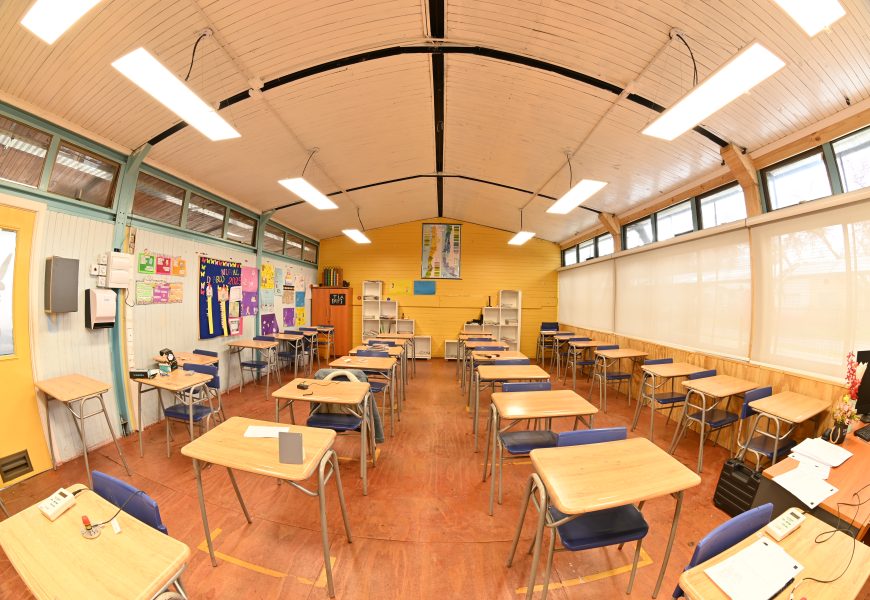
‘Classroom Retrofit’ aims to transform the lighting conditions of school spaces and has already undergone field testing of the first prototypes at the Colonia Árabe School in Los Angeles. In it, a prototype of a light shelf was implemented, a passive strategy in solar control architecture, which harvests daylight by reflecting it through a glazed facade. Built in composite aluminum, its design allows its angle to be adjusted according to the different seasons.
Its application is complemented, explains the academic, “with a simple improvement, which consisted of painting the room’s ceiling white to achieve greater distribution of light inside by rebounding it,” and “replacing the fluorescent tube lights with LED lights (lighting retrofit).” The work was framed within a degree program graduation project, where an automated system with sensors and controllers was developed, enabling the management of light intensity and the automatic shutdown of lights when there is enough daylight.
The project has led to collaboration with academics from UdeC’s Electrical Engineering Department, resulting in the training of advanced human capital and international cooperation, as evidenced by the visit of Dr. Jae Yong Suk, Director of the California Lighting Technology Center at UC Davis in the United States. “He is a world-class expert in lighting, and his participation in the project allowed evaluating the prototypes on-site, obtaining the perspective of the kids and the school, and sharing his knowledge as a global reference in new lighting technologies and their effects on people’s well-being,” explained Dr. Martínez. “They are working on new lighting technologies, they have laboratories where they are doing cutting-edge research, and they see the effects, for example, by measuring brain recordings, on people’s mood according to the light’s different color temperatures,” she said.
Better light in the educational field: More opportunities
The main line of research of the academic at FAUG’s Department of Architecture is focused on improving the interior environmental quality of existing buildings, with a particular focus on Chilean public schools, addressing not only the infrastructure’s efficiency, but also the challenges related to the well-being, health, and productivity of its occupants.
She began working on the topic of building improvement during her doctoral studies at the University of Southern California and, once back in Chile, decided to focus her efforts on the field of public schools, given the need to improve infrastructure. “There were many schools that, in reality, were functioning with very little investment for good maintenance and improvement, even with temporary solutions that have been permanent after the reconstruction following the 2010 earthquake,” Martinez said.
The project with which she joined the FAUG allowed her to start evaluating, in particular, the indoor environmental conditions of schools in the Biobío Region. This led to the creation of the Vital Signs Lab, co-founded by Martínez and Professor María Isabel Rivera Barraza in 2020. With government funding, the lab has acquired equipment to measure lighting, temperature, air quality, and acoustics in classrooms. “These four elements,“ she explained, ”are fundamental to defining Indoor Environmental Quality (IEQ), a broad concept that encompasses the comfort of people inside buildings.”
Currently, the ‘Classroom Retrofit’ project is transitioning from the diagnosis stage to implementing prototyping measures and on-site improvements in classrooms. Meanwhile, the Vital Signs Lab studies buildings from the perspective of their inhabitants, with the aim of improving health, well-being, and productivity. The laboratory addresses these issues from the early stages of design, through simulations, and even into prototyping.
The work of the Vital Signs Lab and Professor Andrea Martínez represents a firm commitment to improving educational spaces in Chile, recognizing that an optimal learning environment is fundamental for student development.
Last modified: 20 de mayo de 2026