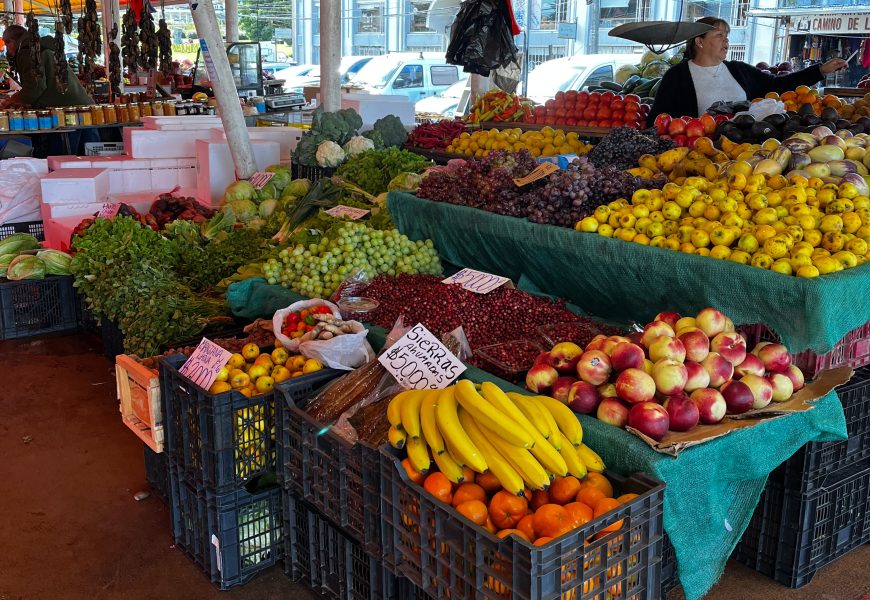
Dr. Magdalena Jensen Castillo is studying how food environments (supermarkets, street markets, and neighborhood businesses) affect people’s diets and the emergence of chronic illnesses, providing scientific evidence to inform public policies that support healthier, more sustainable communities.
By: Carolina Vega Artigues, Journalist – Faculty of Engineering cvegaa@udec.cl
Images: Courtesy of the Department of Civil Industrial Engineering
How does the place where we live influence what we eat? This question has guided the research led by Dr. Magdalena Jensen Castillo, an academic from the Department of Civil Industrial Engineering of UdeC’s Faculty of Engineering, who, together with her team, is analyzing how the characteristics of neighborhoods determine the availability and accessibility of healthy foods, and how these factors condition the health of their inhabitants.
“Food environments represent the relationship of each of us with the food system. Characteristics such as the availability and accessibility of food in our immediate environment are essential elements that help us identify in which category of environment people thrive,” explains the researcher.
This study highlights the incorporation of a local, daily perspective, considering the role of corner shops and businesses as central actors in the food ecosystem. “This seeks to reflect a reality much closer to the day-to-day of consumers, where these businesses have a preponderant role for many people, since they don’t only buy from street markets or supermarkets,” she points out.
Mapping of food environments
The research classifies the neighborhoods according to the predominant type of food in their points of sale, distinguishing three categories:
- Food oasis, where the offer of fresh and healthy products such as fruits, vegetables, or lean meats abounds.
- Food swamps, where ultra-processed products far surpass healthy foods.
- Food deserts, sectors where access to fresh and nutritious food is scarce or non-existent.
“In our research, carried out a few years ago in the commune of Coronel, we observed that most of the neighborhoods are food swamps, with a wide presence of unhealthy food, a phenomenon directly related to higher rates of chronic diseases such as diabetes and hypertension,” says Jensen.
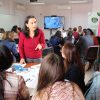
Currently, the academic continues to develop this study within the framework of the Experiential Learning Laboratory (UCO2495). This initiative aims to map the food environments in the neighborhoods surrounding the Concepción Campus of the University of Concepción and promote students’ active learning in the field.
In this way, the project combines teaching, research, and outreach, integrating students of the subject “Climate Change and Food Systems” in the collection of data alongside the community.
The team collects information about points of sale (businesses, supermarkets, cafes, and restaurants) and processes the data using Geographic Information Systems (GIS) and digital tools that allow visualization, in a georeferenced way, of gaps and opportunities in access to healthy foods.
This methodology not only generates scientific evidence but also provides a transformative learning experience for students who actively participate in generating knowledge with social impact.
Health, sustainability, and public policy
Dr. Jensen’s work is situated at the intersection of public health, regional development, and sustainability in the context of climate change, offering an integrated perspective that spans from industrial engineering to contemporary food challenges.
“Less healthy food environments have been linked to a higher incidence of chronic diseases. Our georeferenced results will allow us to make evidence-based decisions to improve health and access to fresh food in our neighborhoods,” says the researcher.
Beyond academic results, this project aims to influence local and national public policies and contribute to a cultural shift: understanding that healthy eating depends not only on individual decisions, but also on the environmental conditions in which people live.
Last modified: 20 de mayo de 2026