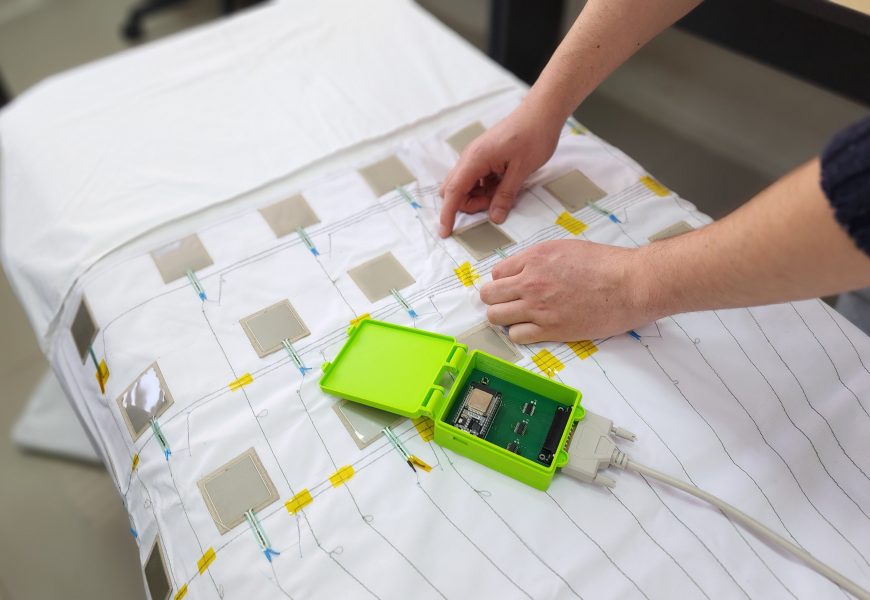
A minimally invasive, sensory bed sheet that combines technological innovation, Artificial Intelligence, and engineering seeks to provide well-being and improve the quality of life for people with a terminal or serious illness.
By: Verónica Gormaz Muñoz, Journalist – Faculty of Engineering vgormaz@udec.cl
Images: Courtesy – UdeC Faculty of Engineering
Using technology, Dr. Esteban Pino Quiroga aims to improve the management of patient monitoring in palliative care. The Professor of Biomedical Civil Engineering is leading a project that, after 10 years of development and several prior iterations, has resulted in the development of an application for patients who require specialized care. “They are people who go home to be calmer during the last stage of their lives. So, what you least want is to be annoying them,” the researcher argues.
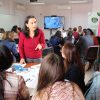
The professor and researcher at UdeC’s Faculty of Engineering says that, in 2019, the initiative was presented at the International Telemedicine, Telehealth and Digital Health Congress in Concepción. After this participation, he was contacted by UdeC alumnus Jaime Jiménez, who works at Health Tracker Analytics, a medical technology company in Santiago. “We started with a pilot in Santiago, with five patients, to see if we were able to deploy the sheet in a person’s house, connect it to the Wi-Fi, and send the data and receive it here at the university, and that was achieved.” It is important to note that the tests are continuing, as they recently obtained the authorization of the Ethics, Bioethics, and Biosafety Committee of the University of Concepción’s Vice-Rectory of Research and Development, for a second stage and testing with 20 simultaneous sheets, installed in Santiago and Concepción, with the support of the same company.
The project was highlighted in the VII version of the Science with Impact Awards, organized by the Transfer and Licensing Office (OTL UdeC) of the Vice-Rectory for Research and Development (VRID). On that occasion, it received one of the 2022-2023 Licenses for research teams that reached agreements to license their research results to external companies or university spin-offs.
More data and minimal inconvenience for patients
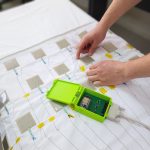
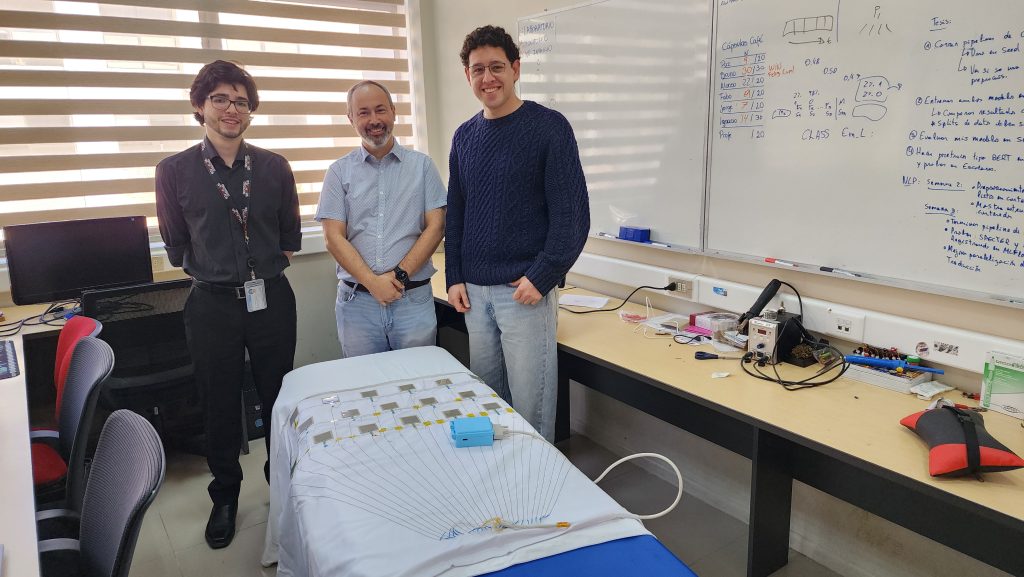
Dr. Pino leads the research team, which comprises UdeC biomedical civil engineers Fabián Alvarado and Bruno Fernández. The sheet currently has 24 sensors and is installed on the mattress, so it is not visible. The patient goes to bed and lives their day-to-day. In this way, one can measure parameters such as how long they are in bed, their progression, and whether they get up less, are restless, change position, or remain in bed.
Another aspect Dr. Pino highlights is that it is possible to measure the respiratory rate, an indicator of the amount of pain you are experiencing. On this point, he explained, “We want to do a slightly more extensive study, with more patients, and see if we can infer, for example, the level of pain and, with that, adjust the medication so that they can rest. Also, if we can measure that they are very agitated, the progression, to establish whether they are spending more and more hours a day lying down, that is an important indicator that life is near the end.”
“We can also detect apnea, which may be an indicator, although we are unsure whether it is related to the progression of the disease,” he explained.
This, said the Professor of Biomedical Civil Engineering at UdeC, will be key to managing home visits for these palliative care patients, avoiding visits when the patient is feeling well. “Currently, a visit is scheduled, for example, once a week, and it may not be necessary, or on the contrary, more frequent visits are required.”
In the next stage, they hope to be able to tell if there are two people in the bed. “For now, it only measures the strongest signal; it does not know if there are two people, for example, the patient and a relative. We also want to improve the algorithms by using Artificial Intelligence, among other actions.”
Last modified: 26 de mayo de 2026