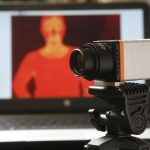
Dr. Sebastián Godoy Medel and his team have devoted nearly 10 years to research that uses engineering to collect and analyze infrared images of dermatological patients, enabling the recognition and categorization of skin conditions.
By: Constanza Gutiérrez Cáceres, Intern, Faculty of Engineering constanzaagutie@udec.cl
Images: Courtesy of UdeC’s Faculty of Engineering
It all began in 2010, when Dr. Sebastián Godoy Medel, an academic and professor at the Faculty of Engineering, was pursuing his doctorate at the University of New Mexico in the United States. His research used infrared cameras to detect skin cancer, conducted in collaboration with the Department of Dermatology at that institution. For two years, Godoy systematically captured images of 100 patients, aiming to replicate the results of American and German studies on the same subject, which demonstrated thermal differences between benign and malignant lesions.
During the research, the academic from the Department of Electrical Engineering and his team noticed inconsistencies in the existing methods, which often misclassified lesions as benign when, in fact, they were not. Faced with this problem, they developed a methodology that consists of a data-capture protocol, processing, and subsequent analysis, using telecommunications theory. The work resulted in a first paper published in 2015, innovatively combining engineering and medicine, laying the foundations for a research path that remains valid to this day.
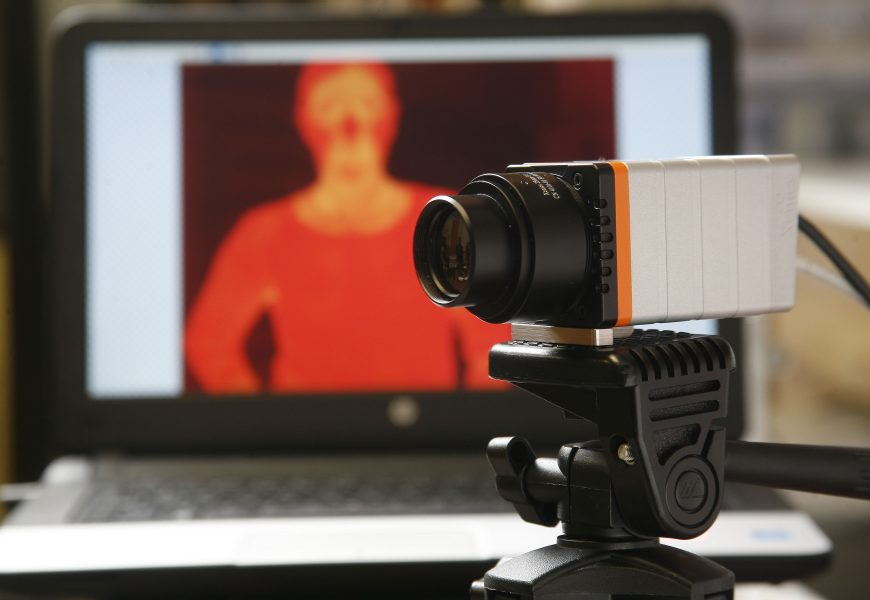
Upon his return to Chile, a new challenge arose: to make the advances developed in the United States accessible in the country, as each camera used in his doctoral thesis cost approximately US$60,000. His return coincided with the sale of low-cost infrared cameras in Chile, and Dr. Godoy was able to acquire three that could be adapted to a smartphone. “I bought a high-end one, worth 20 million pesos, one worth around 2 million pesos, and one worth 200,000 pesos,” the academic detailed. This led to the second stage of the project at the University of Concepción, where, together with two students, he repeated the research at the University of New Mexico. For this, they had to calibrate the hardware, design protocols, and train hospital staff to start collecting data.
One of his students used artificial intelligence to improve images captured by low-cost infrared cameras. At the same time, the other developed a system that predicts the appearance of pressure lesions in hospitalized patients, detecting ulcers even 2 weeks before they become visible. However, the project was paused in 2020 due to the pandemic, which necessitated a change in the research path.
Other uses of infrared light
Other research guided by Dr. Godoy has demonstrated the effectiveness of infrared cameras in medical applications, including vitiligo, burns, wounds, diabetic foot, and vein visualization during blood extraction. With this, it is possible to determine that they facilitate the early detection of skin conditions, predict their progression, and anticipate necessary health procedures.
Currently, Dr. Sebastián Godoy hopes to continue researching in the field of dermatology and the use of infrared cameras. One of his goals is to create a comprehensive initial diagnosis system based on his progress and that of his students, which would generate a complete monitoring of the skin and seek to develop a classification of lesions according to their severity, so that the health system gives priority to those patients who have more complex diagnoses. This idea “would make it possible to organize the dermatology service in hospitals and in rural areas,” he stressed. On the other hand, he would like to move towards comparing the results of thermal skin observation with those of a biopsy.
After more than a decade of research, publications, and undergraduate theses in this line, Dr. Godoy says that they already have the algorithm and the methodology. He hopes to get funding to continue developing the project. The academic said that it is crucial for him “to have a product that can help people, that has always been my goal.”
Last modified: 20 de mayo de 2026