How does astronomy contribute to the study of global warming? Radio astronomers study atmospheric water vapor because it interferes with their observations at millimetric wavelengths. However, that same knowledge contributes significantly to our understanding and prediction of global warming today.
By: Bárbara Iraira Martínez, Journalist – UdeC Department of Astronomy biraira@udec.cl
Photographs: Bárbara Iraira and Esteban Donoso
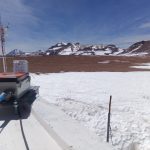
In the Chilean highlands, more than five thousand meters above sea level, radio astronomers study the universe from some of the driest skies on the planet. There, where the air is so thin that it barely contains water vapor, telescopes such as ALMA and APEX observe distant galaxies and the origins of the cosmos. But that same dryness that favors astronomy holds a key to understanding climate change on Earth.
Water vapor is a fundamental greenhouse gas. Although invisible, it regulates the planet’s temperature and amplifies the warming caused by other gases, such as carbon dioxide. Measuring it accurately is a considerable challenge: satellites deliver global data, but with limited resolution, and ground-based observations are scarce. In this information vacuum, the experience of Chilean radio astronomy has begun to play an unexpected role.
From the deep heavens to the Earth’s climate
Millimetric radio telescopes, such as those operating in the Atacama Desert, must constantly correct the interference caused by water vapor in the atmosphere. To do this, they continuously record its quantity and variations. The APEX telescope, for example, has been measuring the water vapor content every minute since 2006, and ALMA, with its 54 antennas, has been doing so every few seconds since 2010.
These records, initially created to improve astronomical observations, constitute a unique database on atmospheric behavior in extreme areas. And now, researchers from the University of Concepción’s Astronomy Department, through the CePIA laboratory and in collaboration with the Milenio TITANs Nucleus and the CATA center, are using them to study global warming. This international project has three branches: comparing terrestrial and satellite data, developing new instruments, and using citizen observations to advance scientific knowledge.
Comparison of ground-based measurements with satellite data
The goal is to verify how accurate the atmospheric water vapor data delivered by international satellite bases (such as NASA’s MERRA-2) is.
To do this, direct measurements from ground-based observatories are compared with those from satellites. So far, 10 years of data have been analyzed from five sites (two in Chile: APEX and VLT), as well as others in Germany, Antarctica, and Hawaii, where systematic differences were found between the soil and satellite values. The next step is to understand why these differences exist, whether due to local conditions, calibrations, or atmospheric models, and to correct the global databases accordingly.
Infrared monitors made in UdeC
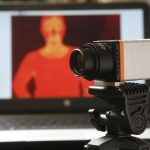
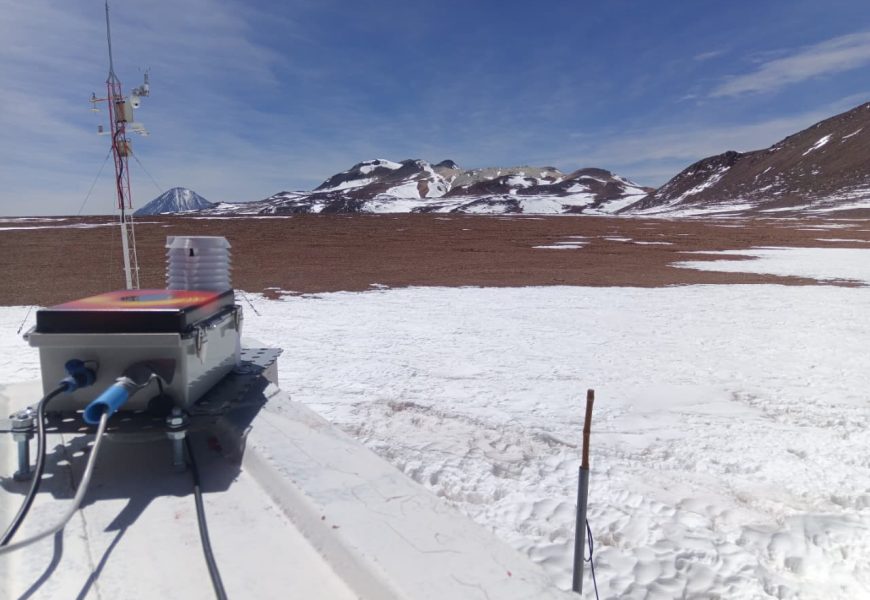
Research has also led to the development of new instruments. CePIA engineers and astronomers are developing low-cost infrared monitors that can estimate water vapor content by measuring the thermal radiation of the sky. Manufactured at UdeC, these devices have been successfully tested at Chilean Antarctic bases and at the APEX telescope in Chile. The same CePIA team is also developing high-precision spectrometers to accurately measure the amount of water vapor, even in the most challenging conditions, such as areas with clouds or coastal regions.
Citizen science
The project also seeks to connect science and community. Through the “Measuring Water Vapor” initiative, funded by ANID, students from schools nationwide use handheld infrared thermometers to measure the temperature of the sky and estimate its vapor content. The data are then compared with satellite models, bringing children and young people closer to climate science and applied astronomy.
The educational impact extends beyond the country: several former project members continue their careers in doctoral and postdoctoral programs at research centers in the United States, Germany, Switzerland, and South Africa.
A new view from astronomy
What started as a technical task (measuring air humidity to observe the universe better) has been transformed into a tool for understanding the Earth’s atmosphere. From the Chilean highlands to the poles, the data and technologies developed to explore the cosmos are helping to understand how the climate evolves on our own planet.
Put simply, astronomy turns its gaze towards the Earth, demonstrating that knowledge of the universe can also illuminate the future of the environment.
Last modified: 20 de mayo de 2026