The proliferation of microalgae in the sea affects the ecosystem and also those who consume contaminated food. However, a group of researchers has studied the effects of these toxins and discovered potential health uses.
By: Paúl Gómez-Canchong, Science Education and Outreach Coordinator, COPAS Coastal / paulgomez@udec.cl
Images: COPAS Coastal Centre, Universidad de Concepción
Harmful Algal Blooms (HAB) are a natural phenomenon that occurs when certain microalgae proliferate explosively, staining the waters and seriously affecting fish and other marine organisms. In Chile, as in many parts of the world, these blooms have generated significant economic and environmental losses, especially in aquaculture and fishing.
Some species release toxins that can accumulate in seafood and fish, poisoning those who consume them. Others can even affect air quality, causing eye and respiratory irritation in coastal communities. That is why HAB represent not only an ecological and productive challenge, but also a public health problem.
Among the most well-known poisonings is Paralytic Shellfish Poisoning (PSP), caused by toxins that affect the nervous system. These substances, produced by microalgae such as Alexandrium catenella, can concentrate in filter-feeding mollusks and, when consumed by humans, cause symptoms ranging from tingling and muscle paralysis to, in severe cases, death. Some of the highest levels of toxicity in the world have been recorded in Chile’s southern fjords.
However, what has long been considered a danger can also become a source of hope. In recent years, science has shown that many natural toxins – produced by plants, bacteria, or microalgae – can have valuable medical applications when studied and used in a controlled manner. An emblematic example is botulinum toxin type A, which went from being one of the most potent poisons known to becoming a therapeutic tool widely used in neuromuscular and aesthetic treatments.
Another remarkable case is that of Neosaxitoxin, a marine toxin studied and developed as a drug by Dr. Néstor Lagos Wilson, from the University of Chile. At microgram doses, it has demonstrated efficacy in the management of postoperative pain for up to 72 hours without producing the typical side effects of traditional local anesthetics, whose action usually wears off after 6 hours. In addition, its use has been evaluated in various pathologies, ranging from tension headaches to disorders of the lower esophageal sphincter.
A microalga under the magnifying glass
Following this line, a team from the University of Concepción’s COPAS Coastal Center, led by the engineer Alejandra Rivera Latorre and Dr. Allisson Astuya Villalón, and with the support of Dr. Juan José Gallardo Rodriguez, from the University of Almería, Spain, investigated Karlodinium veneficum, a marine microalga known to produce compounds that can cause the death of fish during HAB. But what can be a problem at sea can become an opportunity in the laboratory.
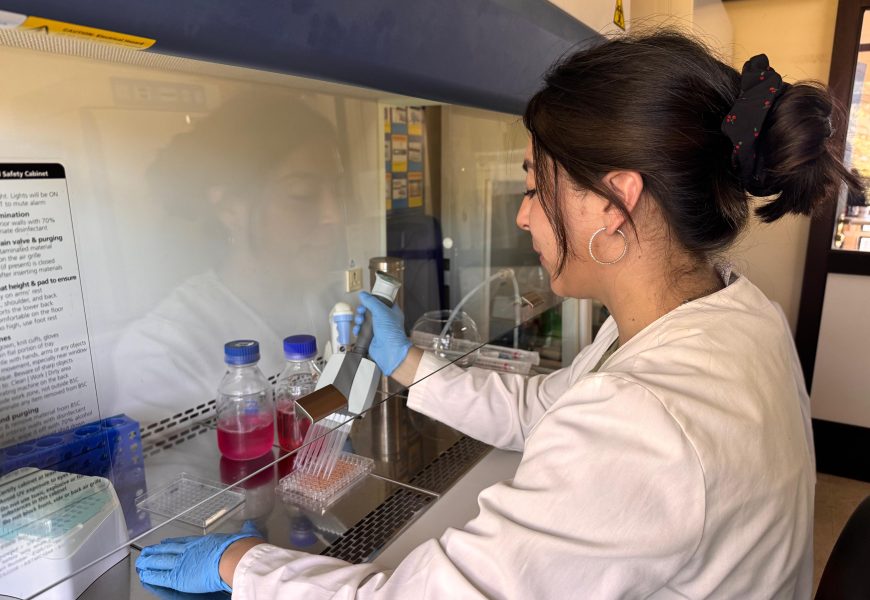
Using photobioreactor technology, the researchers cultivated this microalga under controlled, reproducible conditions, allowing the safe production of biomass and compounds. Then, they separated and analyzed the metabolites it releases into the water during its growth (extracellular metabolites) to study their possible effects on human cells.
From marine poison to a potential drug
The results were surprising: extracts from the medium in which K. veneficum grows showed high anticancer activity, eliminating breast and colon cancer tumor cells under laboratory conditions. Depending on the cell type, the toxins acted differently: in some, they triggered apoptosis, a controlled, orderly form of cell death; in others, they caused rapid necrosis.
These findings reveal that the compounds produced by K. veneficum could have promising uses in marine bioprospecting, a field that seeks to discover new products useful for medicine, industry, and biotechnology from ocean organisms.
This study shows how scientific research can put a positive spin on environmental problems, transforming a natural threat into a source of knowledge. Thus, microalgae that were once seen only as a threat to ecosystems and human health are now emerging as allies in the search for future therapies, reminding us that the ocean not only holds mysteries but also solutions.
Last modified: 20 de mayo de 2026