By: Xuksa Kramcsak Muñoz, Journalist – Institute of Ecology and Biodiversity (IEB) / xuksa@ieb-chile.cl
Images: Courtesy of the Biological Invasions Laboratory
Leer en español
What began as an experiment in the 1970s to evaluate the growth of different tree species, and thus diversify the productive timber matrix, became one of the clearest examples of how an exotic species can transform an entire ecosystem due to a lack of management. At that time, the potential of the Pinus contorta, a species today categorized as one of the most invasive trees in the world, was unknown.
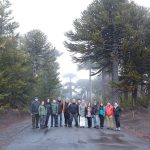
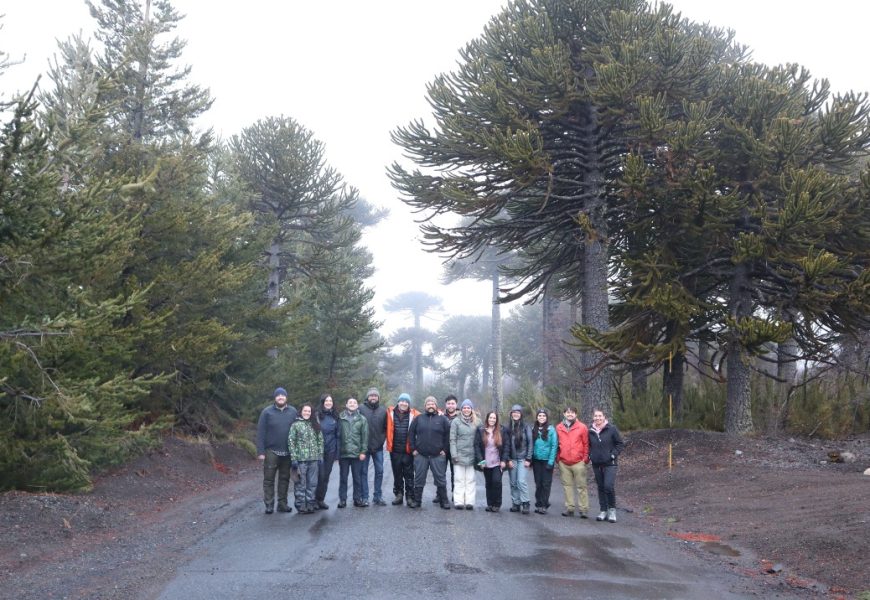
The scene is already commonplace for those visiting the Malalcahuello National Reserve. When approaching, next to the majestic araucarias, one notices the presence of pines that increase in quantity and size inside the native forest, displacing native species. “In the 2000s, together with Professor Eduardo Peña of the Faculty of Forestry Sciences of the University of Concepción, we detected that the pines originally planted in small experimental plots were invading araucaria forest areas,” recalls Dr. Aníbal Pauchard, Director of the Institute of Ecology and Biodiversity (IEB) and founder of the Biological Invasions Laboratory (LIB, in Spanish) of the UdeC Faculty of Forestry Sciences.
High-level scientific evidence
At the end of the 2000s, the invasion of the Pinus contorta began to affect a greater extension of the araucaria forests and became a priority for the LIB team. Thus, they started a series of projects and initiatives to generate evidence about this invasion. In parallel, with the creation of the Mountain Ecosystems Research Station (ESIEM, in Spanish), which brings together several UdeC faculties, it was possible to have logistical support in the area. “It was an early warning. Since then, we have tried to understand and mitigate the impacts of this invasion, pending a formal solution to this threat,” adds Pauchard.
From an ecological perspective, it has been found that pine not only competes with other plants, but also generates profound changes in the ecosystem. This species significantly modifies the microclimate (light, humidity, and temperature), the soil structure, and the presence of insects, birds, and mammals. It also influences aspects of the landscape. “From invaded areas, tourists no longer see the Lonquimay volcano because of a true ‘wall’ of pines, and in denser areas, the araucarias disappear from the landscape,” explains Rafael García, Director of LIB. It also increases the risk of forest fires. “The presence of pine trees increases the total fuel load, with a high proportion of fine fuel, which favors the spread and intensity of the fire,” he warns. Through international collaborations, researchers have even managed to identify that several mycorrhizal fungi (which connect to the roots of trees) are co-invading the area next to the pines.

Since this problem was detected, the LIB has worked with CONAF to search for management strategies such as felling (cutting individuals), banding (debarking of living trees), and restoration (recovery of the original ecosystem). However, the main obstacle has been the lack of resources. “We have the data and the tools, but they haven’t been prioritized at the state level,” Pauchard says.
Malalcahuello has been registered in the Mountain Invasion Research Network (MIREN), which is key to positioning this case globally. “Thanks to this network, we have made what is happening here visible as a global example. We know how to handle it, but there is a lack of political decision,” says García.
The disconnect between science and action
Today, the total eradication of pine is unfeasible. However, it is possible to contain its expansion and restore critical areas. “Every year that goes by, the cost is higher and the effectiveness is lower. If action had been taken on time, the problem today would be different,” concludes Pauchard. “We live in a country with limited resources for conservation and multiple threats. That is why it is key to prioritize strategies with more effective results,” says García.
Looking to the future, both researchers highlight the social role assumed by UdeC. “We are part of the territory now. The community recognizes us as a legitimate voice,” they point out. “We have always been ready to collaborate. Now that the science is there, we need the political will to transform that evidence into real solutions,” Pauchard highlights.
In this line, García believes in the importance of interdisciplinary collaboration and making this problem visible from other areas, such as scientific communication. An example was the participation and collaboration in the production of the documentary series Invasores from UChile TV, which had six episodes about invasive species, one of them dedicated to pines: “Communication and interdisciplinary collaboration with other areas is a way to strengthen respectful and ecological tourism,” he says. In turn, he hopes that these actions to strengthen environmental awareness in the territories will be aligned with the future implementation of the Biodiversity and Protected Areas Service (SBAP, in Spanish) and with the official list of priority invasive species, key tools to protect our environment and ourselves.
Check out the documentary series INVASORES (INVADERS)
Which landscape do you prefer? That was the question posed to visitors to the Malalcahuello National Reserve to determine their perception of the pine invasion. Spontaneously, the respondents mainly chose images of Araucaria forests, negatively evaluating landscapes dominated by pines, even without knowing that they are an invasive species. The research revealed that the appreciation of the landscape also changes when one knows the adverse effects of this species.
Last modified: 3 de septiembre de 2025