Adapting to climate change is no longer optional for the port and fishing sectors. Two initiatives are strengthening essential sectors for the Chilean economy.
By: María Luisa Garrido Canaves, Collaborator, COPAS Coastal / mgarrido@oceanografia.udec.cl
Images: Courtesy of COPAS Coastal
The Port CDOM (CDOM Portuario) project, led by the COPAS Coastal Center, is an example of science applied to monitoring systems, opening the doors to another project: Fishing CDOM (CDOM Pesquero). The story of both has its origin in the alterations to our coasts caused by climate change, for which APOLINAV – now CITA – has laid out the situation to the ANID Public Challenges program, calling on companies and study centers to propose solutions.
Years of experience
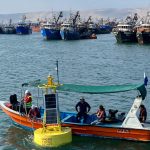
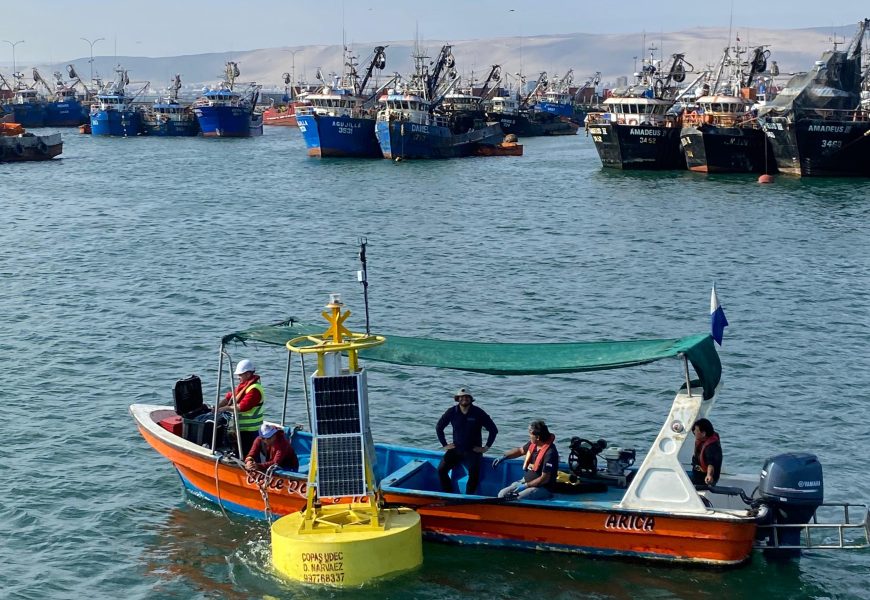
Since 2022, CDOM Portuario has gone through two stages and today has buoys in Arica, Antofagasta, and Coronel. These collect information on waves, currents, and wind, which is provided to Port Captains through a digital interface. The project has made the opportunities for real-time predictive information visible, prompting some port companies to recognize the value of operational management and to request more advisory services. According to the Project’s Director, Diego Narváez, CDOM Portuario has also allowed them to improve skills in monitoring maritime conditions and handling buoys with a more operational approach. “This means we can respond much faster to any situation they may face (…). We have learned to be more effective in keeping the buoys running for a longer period of time,” he says.
Recently, they had to rescue a buoy in Antofagasta with the help of the harbor master’s office and other companies, which highlights the importance of teamwork. “Clearly, these are events that happen during the day, so it doesn’t give us time to get there ourselves to rescue the buoys. That is why we must have people trained in this field so that they can do it. (…) It requires a large group of people who do not work in COPAS directly, finding people from the localities where they are installed who can support us in these events,” he explains. This is part of the challenge of working with oceanographic buoys, including the transport, installation, and maintenance of heavy, delicate equipment. Challenges that COPAS faces with its six currently operational buoys.
New horizons
The experience of CDOM Portuario has helped prepare a more well-versed team in operational oceanography and has enabled them to address other maritime needs. According to Cristian Vásquez, in charge of technological transfer at CDOM Pesquero, regional fishers are greatly affected by meteorological variability, particularly wave height and wind. In addition, water temperature is a key indicator to identify areas where resources are available. “Today they use tools on a regional scale and with outdated information, which is why they need greater precision to make decisions,” he says.
This is how CDOM Pesquero was created: by drawing up a collaborative project to provide information collected with buoys and sensors used in the fishing nets. “The regional fishing sector is the most important in terms of landings at the national level (…) The fleet consists of 635 sardine boats, each with 8-10 crew members. We are talking about 6,000 fishers who depend directly on the sea”, comments Cristian Vásquez.
Both projects demonstrate the value of technology transfer. According to Sandra Espinoza, executive director of the unit in charge of this aspect (MOTOR): “Researchers have a vocation focused on the generation of knowledge, whether in the academic or scientific field. (…) Someone must support the identification of opportunities, as well as the knowledge needs that arise from companies or society, with the capacities to search for and raise available funds and establish strategic links with organizations and environmental actors.”
Thanks to this joint work, the Biobío region not only produces knowledge but also transforms it into real solutions. The CDOM Portuario and CDOM Pesquero projects thus consolidate the region’s role as a true ocean monitoring pole, where collaboration among science, industry, and the community is a key tool for adapting to climate change and protecting the ocean’s future.
Last modified: 26 de mayo de 2026