
By: Soledad Toledo Cabrera, Journalist VRID UdeC / lucabrer@udec.cl
Images: Archive OTL UdeC
Leer en español
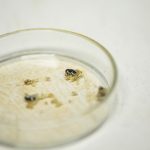
They are not even 5 millimeters in size, but their presence in pine lumber for export can cause millions of dollars in losses. We are talking about the pine bark beetle, a quarantine pest in domestic wood destination markets such as the United States and Mexico. This insect not only damages the wood by nesting in it, but it is also a vector of fungi that stain its surface, reducing its commercial value. The detection of insects in the wood for export can mean the total rejection of the cargo, resulting in costly reprocessing, delays, and even the closure of the market.
A team of researchers, led by Dr. José Becerra Allende, from the Department of Botany of the Faculty of Natural and Oceanic Sciences, has been dedicated to finding a natural repellent capable of disguising the smell of wood and avoiding the attack of this insect.
In Chile, the industry applies insecticides and treatments, both in plants and at ports, to control this pest. Dr. Becerra explains, “There are chemical, synthetic insecticides, but they all have the problem of leaving behind toxic waste. Therefore, the first thing was to look for an alternative that is not toxic for the people who work in the sawmills.”
It is about finding the solutions that nature itself offers. To do this, the team analyzed the insect’s behavior and observed that the smell of pine attracts it. Perhaps there are smells that it prefers and others it dislikes? Thus, they tested different essences of native plants such as boldo, peumo, thyme, and eucalyptus in the laboratory. “We saw that eucalyptus manages to mask the smell of pine and is not pleasant for the insect; if it is applied to wood by spraying, we have a natural repellent,” said Dr. Becerra.

On the way to the market
The new product obtained from eucalyptus leaves allows reducing the presence of pine bark beetles by 85-90%. It can be used in open and closed spaces without interrupting operations, since it is harmless to the environment and does not affect people’s health. It is also biodegradable, both in its liquid and powder forms.
One of the difficulties the team faced was increasing the duration of the repellent’s effectiveness. “It is a volatile product, which is necessary so that the antennae of insects can detect it. We have worked on increasing the compound’s durability so that it lasts longer, and it is not necessary to apply it daily.” In this way, they have achieved up to 20 days of durability, thus covering the critical period from sawmill production to export.
This initiative, which began with a project financed by ANID through the Fondef program, then CORFO, and with the support of APTA’s Fill The Gap program, progressed towards scaling up. “In addition to the laboratory tests, we did field tests, on an export scale, with the help of forestry companies,” says Dr. Becerra. ARAUCO, Bioforest, CMPC, and Bio Insumos Nativa are among the companies that have collaborated in this development, the latter being interested in its commercial licensing.
The scientific team, mainly comprising members of UdeC’s Natural Products Chemistry Laboratory, consists of Dr. Claudia Pérez, Miguel Peredo, Karina Crisóstomo, Ignacio Tello, and the project manager of OTL UdeC, Muriel Sandoval. Together, they have made progress in the maturity of the technology for its market launch. “We are satisfied, because we have found a natural, environmentally friendly product, and that in the case of insect control, such as the pine bark beetle, it is the most innovative thing there is,” said Dr. Becerra. “It means that what we did was worthwhile, it has applications, and it has a future,” he said.
Last modified: 3 de septiembre de 2025