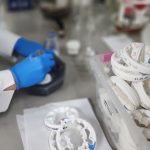
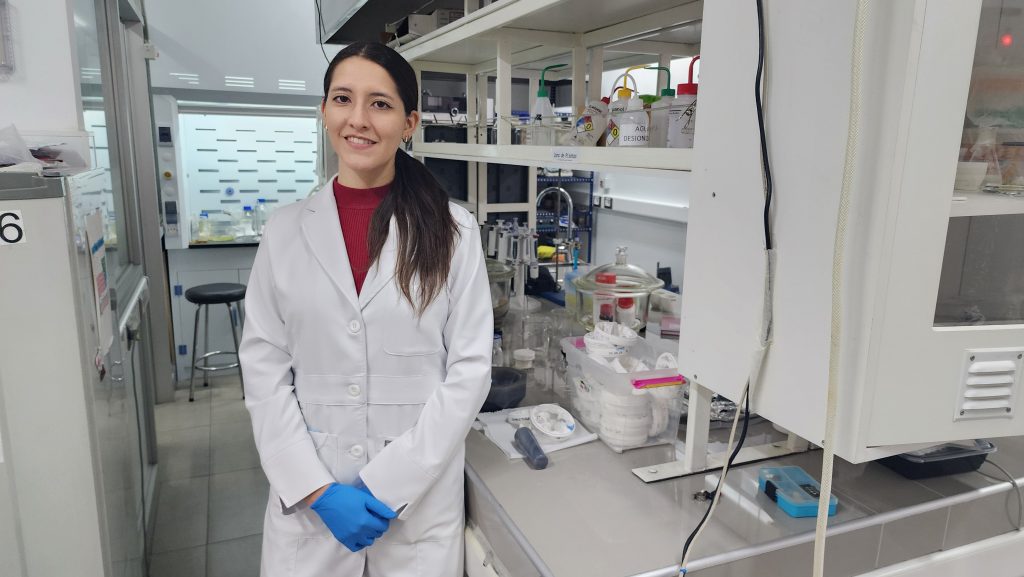
The project by dentist and doctoral student in Materials Science and Engineering at UdeC, Elizabeth Parra, addresses a relevant problem in dental biomaterials, aiming to combine mechanical and aesthetic resistance in high-functional-demand restorations while reducing environmental impact.
By: Verónica Gormaz Muñoz, Journalist – Faculty of Engineering vgormaz@udec.cl
Images: Courtesy of UdeC’s Faculty of Engineering
Based on the reformulation of dental zirconia, Elizabeth Parra Gatica, the UdeC dentist and current doctoral student in Materials Science and Engineering at the University of Concepción’s Faculty of Engineering, is seeking to improve the material’s aesthetic and mechanical properties while incorporating recycling into this initiative.
This is an innovative and sustainable solution that directly impacts people’s oral health and well-being. The project, called Development of multilayer zirconia discs with composition gradient for dental applications and post-processing reuse was one of the two Doctoral initiatives of the FI UdeC that won the National Research and Development Agency’s (ANID) Doctoral Thesis in the Productive Sector 2025 Competition, which aimed at strengthening ties with companies, innovating, in this case, in the area of dentistry and energy efficiency.
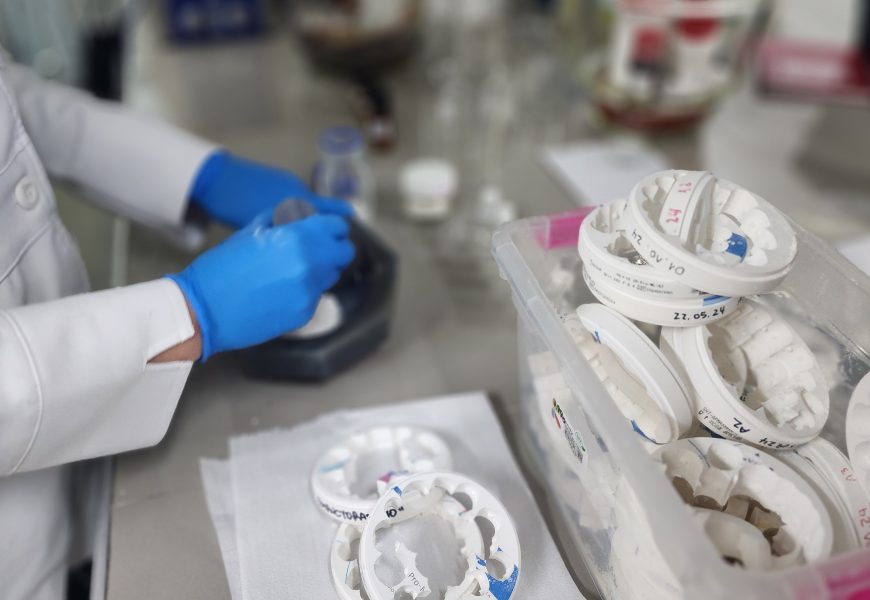
Dental zirconia is a durable, aesthetic ceramic material used to manufacture dental pieces. Its commercial format is on discs and stands out in the world of dental resins, which are limited in the types of restorations they can be used in. There are also supplies for more complex restorations, such as ceramic and metal for amalgams and aligners, although they are being used less frequently.
In this regard, the PhD student in Materials Engineering explained that conventional zirconia (3Y) is excellent in terms of strength, but its opacity limits its aesthetic use. As a solution, multilayer discs with varying concentrations of yttria (4Y-5Y) have been developed, aiming to strike a balance between aesthetics and resistance. However, these configurations have decreased mechanical properties, limiting their use only to lower functional demand restorations: “Laboratories should consider this, since their improper use can lead to clinical failures,” Parra said.
Valuing waste
The goal of this project, the researcher said, is to develop a dental zirconia formulation that improves both its aesthetic and mechanical properties, with a focus on making it recyclable. “Currently, the milling or carving of these restorations generates up to 80% of solid waste, and there are currently no recovery strategies,” he said.
Parra’s research combines the generation of advanced knowledge in materials science with an applied approach to technological innovation, since it links the development of a material with a circular economy model. “This is particularly relevant in Chile, where there are still no companies dedicated to the local production of dental ceramic materials. At the same time, the growing clinical digitalization has increased both the demand for zirconia discs and the generation of solid waste from milling.” In this context, the research aims to contribute to the productive sector by providing a sustainable alternative that promotes both national technological development and sustainability.
Another aspect to highlight, said Parra, is that the work with the company has been of great value and has allowed incorporating the direct perspective of the end user, enriching the research with a practical, applied perspective. “In this case, the project is linked to the Ornella Ivonne Contreras Ferrada Dental Laboratory, EIRL, which not only guides the initiative towards the sector’s real needs, but also enhances the technology transfer process and the possibility of generating a tangible impact on clinical and productive practice.”
Last modified: 28 de mayo de 2026