
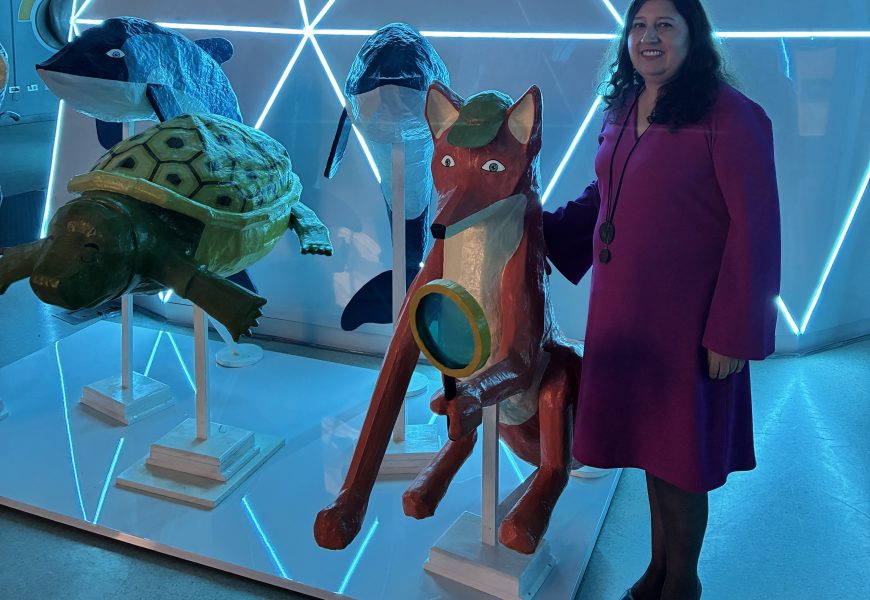
CICAT’s “My Super Brain” room has been updated with the arrival of the EMOCREA project, which offers the public new experiences on neuroscience, mental health, and education.
By: Gonzalo Medina Parra, Journalist of the Interactive Center of Sciences, Arts and Technologies – CICAT gomedina@udec.cl
Images: CICAT
An update of the “My Super Brain” room (2016) at the Interactive Center for Sciences, Arts and Technologies, CICAT, has been conducted by the researcher and professor of the University of Concepción’s Faculty of Education, Dr. Mabel Urrutia, who is leading the team of the Fondecyt Exploration project 13220040, entitled: “EMOCREA, discover and recreate your emotions in virtual reality environments using neuroscientific and artificial intelligence techniques.” The renovated room offers the public a new exhibition on neuroscience, mental health, and education. Its objective is to address the lack of emotional education in the Chilean school system, identified as a contributing factor to the serious mental health problems of schoolchildren in the country.
The issue of mental health has been given a leading role in public discussion in Chile, as a result of the COVID-19 pandemic at a global level. Several studies have been conducted to monitor the state of mental health in the population, particularly within the school community. Data from a post-pandemic article published in 2024 revealed that 60.2% of students showed symptoms of depression, 63.6% of anxiety, and 50.2% of stress.
How can emotions influence physical and cognitive responses?
The CICAT’s new permanent exhibition offers visitors an interactive tour divided into four learning environments: recognition, expression, emotion regulation, and empathy. These topics are addressed through various museographic strategies, including virtual environments that train emotional competencies. In the room, visitors can interact with digital devices, including 3D immersive reality viewers, video projections, facial recognition technology, digital games, reading tablets, and exercises that promote stretching and conscious breathing dynamics.
The interdisciplinary research team, comprising academics from the Faculties of Education, Engineering, and Psychology, developed three innovative systems that integrate various technologies to address emotions. In the new exhibition, a ChatGPT-supported system was implemented to help schoolchildren develop the ability to identify and understand the emotions they see in images and videos. Additionally, a Convolutional Neural Network (CNN) is used, which is trained to recognize seven basic emotions: happiness, sadness, anger, surprise, fear, disgust, and neutrality. In this game, students can practice expressing these emotions in front of a camera, and the system provides them with immediate feedback on their performance. Finally, the machine learning application teaches them the emotional regulation technique, ‘Alba Emoting’, which is based on the use of conscious breathing to help process and manage negative emotions effectively.
As the professor and Dr. Mabel Urrutia mentions: ”At CICAT, four learning environments have been created that include virtual pets, inspired by our Chilean fauna, with characteristics specific to the emotional competencies to be developed, such as the Culpeo Fox for the recognition of emotions, the Caco Monkey, the Macaque for the expression of emotions; the Tortulina Tortoise for the regulation of emotions, and the Toninas for the development of empathy,” she explains. These pets guide the training of emotions in a central dome, which was built in the middle of the room, emulating the proper functions of a brain. “In the dome, we have developed two virtual reality games with Oculus, to play with the brain in different training rooms; another game to train empathy in an Oculus that invites you to put yourself in the shoes of another with different abilities such as autism spectrum condition, blindness, motor disability, and older people,” says the project director.
Last modified: 20 de mayo de 2026