
By: Iván Tobar Bocaz, Journalist – CI2MA Center for Mathematical Engineering Research / ivtobar@udec.cl
Images: CI2MA
Leer en español
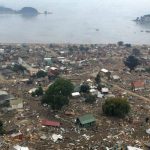
Coastal forests can be a measure to avoid the damage caused by a tsunami. Measuring their effectiveness is the purpose of the thesis ‘Non-hydrostatic Hyperbolic Shallow Water Models for Tsunami Propagation and Coastal Vegetation Impact‘ by Jorge Moya Abuhadba, Ph.D. candidate in Applied Sciences with a minor in Mathematical Engineering from the University of Concepción, who is working under the guidance of UdeC Professor, Dr. Raimund Bürger, and Dr. Enrique Fernández-Nieto, from the University of Seville, Spain.
The scientific team has compiled bibliographic data on scenarios where this type of catastrophic event has occurred, such as the south-central coast of Chile, Sri Lanka, and Thailand, and also characterized the behavior of the different tree species in each area.
Direct applications
Although his initial training is in theoretical physics, Moya explains that he has developed an interest in more direct mathematical modeling applications, in phenomena that can impact society. “It was in this context that the possibility of participating in this research, focused on the interaction between tsunamis and coastal forests, arose, where theoretical challenges are combined with a clear applicability,” he explains. In this way, his thesis aims to study fluid dynamics. He collaborates with Dr. Bürger, Deputy Director of the Mathematical Engineering Research Center, CI2MA, and a member of the University of Chile’s Center for Mathematical Modeling (CMM).
The collaboration with Dr. Fernández-Nieto came after the experience of Dr. Bürger, who had already worked with him on initiatives related to flow models. “When we started developing the model, it became clear that Professor Fernández-Nieto’s experience would be key for the project’s numerical part. It was a very rewarding collaboration from the technical and human point of view,” says Moya.
Real landscapes and various species of trees
The project analyzes different scenarios based on existing experimental data. “Each species has particular physical properties, such as the height of the tree, the diameter of the trunk, the density of the foliage, and the number of trees per square meter,” he explains. These factors directly influence drag and inertial forces that act on the water flow, “and therefore, on how effective that forest can be as a natural barrier against a tsunami,” he summarizes.
“The interesting thing is that the model we developed is quite flexible,” says Moya. “If we have the physical data of any local species — for example, native trees from Chile – they can be incorporated directly into the simulations and obtain specific results for that context. So, beyond the cases studied, one of the approach’s strengths is adapting to different vegetation types depending on where you want to apply it.”
Restore to be better protected
Regarding the main results of the research and its uses in geophysics and disaster management, Moya highlights that the numerical model accurately simulates the protective effect of a coastal forest. “From the point of view of geophysics, it provides tools to study wave propagation in terrains with complex vegetation, and how different tree configurations influence the flow dynamics.”
Regarding disaster management, the model can be a valuable tool for designing mitigation strategies based on natural solutions. “For example, it makes it possible to evaluate the effectiveness of different vegetation densities or to select more suitable species as natural barriers, according to their geometric and mechanical properties.”
Moya adds that this model promotes using native vegetation instead of artificial solutions, such as breakwaters or rigid infrastructures, which are usually expensive and can alter the local ecosystem. “Restoring or preserving coastal forests not only helps to reduce the impact of extreme events, but also contributes to conserving biodiversity and protecting the environmental balance of the area,” he concluded.
Last modified: 3 de septiembre de 2025