Construction of UdeC’s new clinical simulation space is progressing; it will be the largest of its kind in Chile and will include curricular adjustments and teacher training, advancing cutting-edge learning, convergence, and educational transformation.
By: Daniel Tapia Valdés, Journalist – Noticias UdeC dtapia@udec.cl
Images: Esteban Paredes Drake, Photographer – UdeC Communications Directorate
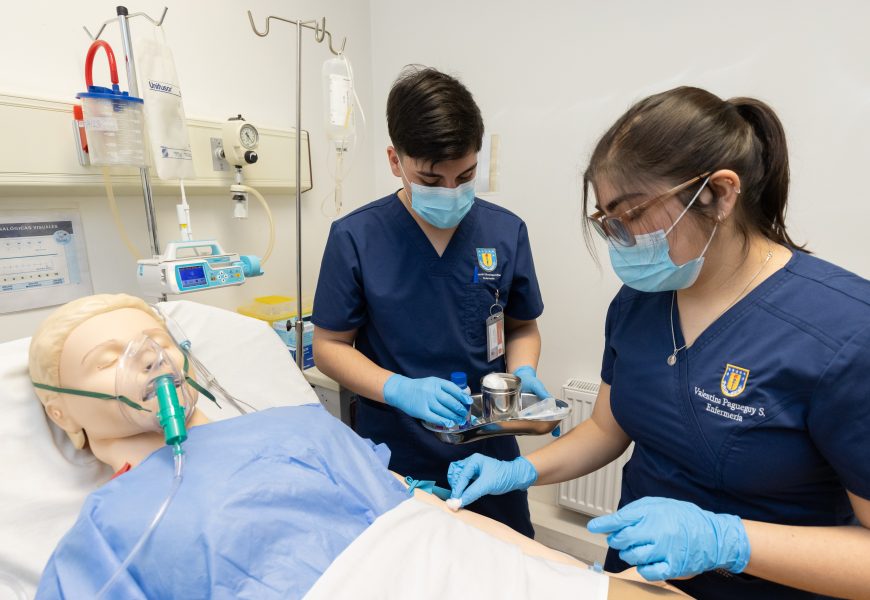
Committed to excellence in training, the University of Concepción is developing a series of initiatives to strengthen learning in the health sector. In this regard, the institutional development project UCO22101 is promoting clinical simulation as a teaching, learning, and evaluation methodology across the Medicine, Pharmacy, Dentistry, and Nursing faculties.
The objective of this initiative, which considers curricular adjustments, teacher training, and the construction of a modern Institutional Health Simulation Center (CISS UdeC), is that the students improve their skills, attitudes, and abilities linked to their profession in a safe and controlled environment, putting them at the heart of the educational process.
In this line, UdeC’s Vice-Rector, Dr. Paulina Rincón González, explained that “in recent years we have seen how the health system is facing difficult situations and scenarios, with high demand and an overload of care needs. In this context, with this comprehensive educational innovation methodology, we are preparing students to think critically, adapt to uncertainty, and act responsibly with commitment, efficiency, and excellence through prompt attention and dignified treatment of those they are consulting.”
At the forefront of healthcare
The comprehensive educational innovation methodology being developed at UdeC is a concrete, direct response to the significant challenges facing Chile’s health system. “It allows training professionals capable of acting safely, permits forming criteria and also working on empathy, emphasizing that every decision, no matter how small, will have a real impact on people’s lives,” the Vice-Rector stressed.
“Implementing clinical simulation at an institutional level and in a transversal way in health degree programs implies an important paradigm shift that redefines the traditional ways of teaching by training students with competencies that combine the technical, the human, and the ethical. A learning through systematic training that impacts the practice of future care,” Vice-Rector Rincón mentioned.
For an organic and mandatory implementation in the training paths of the nine health area degree programs involved in the project, the initiative includes curricular adjustments that have already been reviewed and approved by the Academic Council and the respective Degree and Faculty Councils, explained the Director of Teaching, Dr. Carolyn Fernández Branada.
Along with these adjustments, the teaching staff is also updating and validating knowledge in the field of simulation through the Diploma in Clinical Simulation, so that, once CISS UdeC comes into operation in March next year, it will be quickly incorporated into the training processes.
The largest in Chile
CISS UdeC will be the largest in Chile and will have a total area of 4,489 m2, spread across four floors, including patient care areas, simulation rooms, skill rooms, an auditorium, living spaces, administrative areas, restrooms on every floor, underground parking, and storage rooms. It also has a basement with storage rooms, parking lots, a meeting room, and an auditorium.
The infrastructure has been designed not only with sustainability criteria in mind, but also with technological innovation and academic excellence, aiming to raise the standard of training for future professionals.
The building, with 80% progress and a projected opening in January 2026, is the University’s first to obtain the Sustainable Building Certification (CES, in Spanish). This accreditation, which is part of the national system aimed at evaluating, rating, and certifying the environmental performance of buildings in Chile, contributes directly to UdeC’s Institutional Strategic Plan, in its objective of strengthening institutional management and resources by ensuring compliance with sustainability and efficiency criteria in the management, operation, and investment processes.
The UdeC Institutional Health Simulation Center will vitalize the training of more than 6,000 students from the Biochemistry, Nursing, Pharmacy, Speech Therapy, Physiotherapy, Medicine, Nutrition and Dietetics, Obstetrics and Child Care, Dentistry, and Medical Technology programs across four faculties of the University.
Last modified: 28 de mayo de 2026