The “hidden curriculum” is part of the unwritten norms, values, and practices that students learn during their training period. A group of academics has been researching how to create positive environments that encourage future professionals to treat people properly in healthcare settings.
By: Solange Pino Ruiz, Journalist – Faculty of Medicine solanpino@udec.cl
Images: UdeC Faculty of Medicine
The university educational process has tremendous transformative potential, especially in health degree programs, where future professionals are expected not only to acquire technical skills but also to assume ethical and humanistic roles.
However, the training experience is marred when the educational environment includes situations related to contempt and harassment, phenomena linked to the so-called “hidden curriculum”.
A group of Chilean academics has carried out research to address this problem head-on. This project seeks to generate conceptual clarity to create positive environments in the university context. Researchers from the University of Concepción are leading the project, with the participation of Chilean universities such as Bío-Bío, Austral, Católica de la Santísima Concepción, Chile, Valparaíso, Católica del Norte, Los Lagos, Aysén, and Central.
The research is funded by the National Research and Development Agency (”From Mistreatment to Good Treatment” 2022-2026, ANID-Fondecyt N° 1221913) and was proposed to conceptualize the meanings of mistreatment and good treatment from the direct perspective of health degree program students in Chile.
At the University of Concepción, Professor Nancy Bastias Vega, the project’s director, explains the importance and necessity of this research. “Historical evidence on mistreatment has shown that its consequences include discouragement, depression, fear, and frustration in students.” In the Latin American context, abuse is commonplace. In fact, she adds, a previous study in Chile found that an alarming 98.11% of undergraduate medical students had experienced mistreatment. “These figures show that there is an urgent need for actions to protect the physical and emotional well-being of students,” says the professional.
To achieve this conceptualization, the study used the Natural Semantic Networks (NSNS) technique, which captures the subjective meanings individuals associate with specific concepts. The research involved 994 students from 12 health majors at nine Chilean universities.
The meanings of mistreatment and good treatment
The results showed a high semantic richness: more than 4,000 words were associated with each concept, indicating that both terms are highly polysemic, that is, loaded with multiple meanings, ideas, and emotions.
Words such as aggression, abuse, and violence were associated with the concept of mistreatment. In turn, abuse was categorized into latent (implicit) dimensions, those manifestations that are not always visible in specific behaviors such as violence, discrimination, harm, and power; and explicit (observable), that is, specific behaviors that an individual exercises against another, such as humiliation, contempt, blows, and insults.
The concept of good treatment, seen as an ideal condition for a positive clinical relationship, also showed a strong semantic core, with elements of recognition and reciprocal appreciation, such as respect, empathy, and kindness, prevailing. As with mistreatment, the study defined good treatment as encompassing both latent and explicit dimensions, such as respect, empathy, happiness, and trust, as well as understanding, listening, support, and communication.
In another area of analysis, the study showed that the conceptualization of mistreatment is related to the students’ training cycle (preclinical or clinical). In contrast, for good treatment, statistically significant relationships were observed with the training cycle and students’ gender. For example, students of the preclinical cycle emphasize “respect” and “understanding” more, while clinicians emphasize “empathy” and “kindness”. Women, on the other hand, tend to place greater weight on words such as “respect,” “empathy,” and “love.”
Impact and the future of health training
As for results, the professor points out that this research highlights that good treatment constitutes a condition a priori for academic well-being, since the ability to establish empathic, respectful, and affectionate relationships shapes the training experience. She adds that the findings are crucial. They provide the necessary conceptual guidelines for higher education institutions to generate consensus on which behavioral manifestations are permissible and which are not in learning spaces.
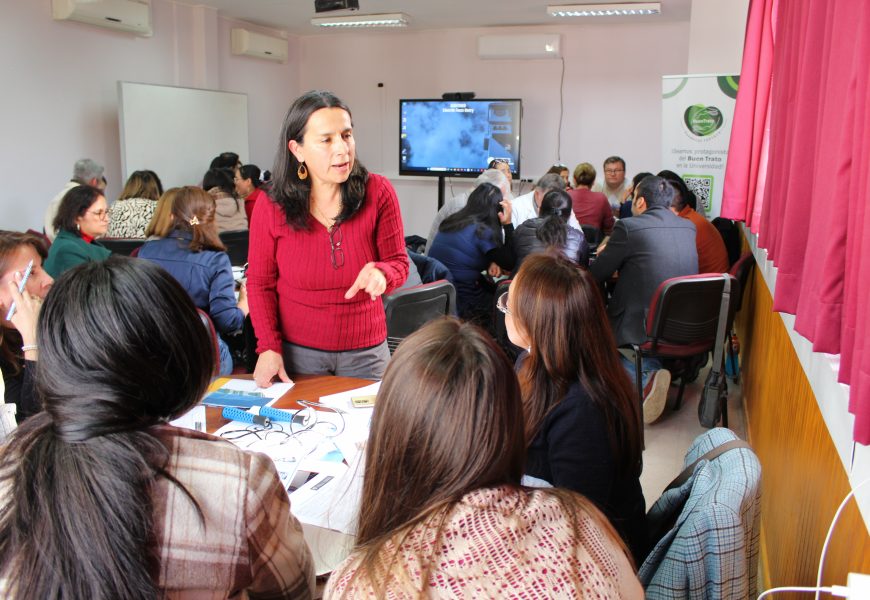
Looking to the future, Bastías points out that she intends to hold co-creative design meetings between students and teachers to develop “decalogues” on mistreatment and good treatment, thus guiding the various Chilean higher education institutions. “Our ultimate goal is that, in each University, we work on the design of a decalogue of good treatment, adapted to each reality, and that it is not just a document or a statement of intentions, but an explicit form where kind and respectful treatment prevail.” She also mentions that “ultimately, a culture of abuse prevention and the fostering of treating people the right way is essential to prepare ethical, empathetic, and effective health professionals.”
Publication in the journal, Behavioral Science (WOS), 2024
Last modified: 9 de junio de 2026